


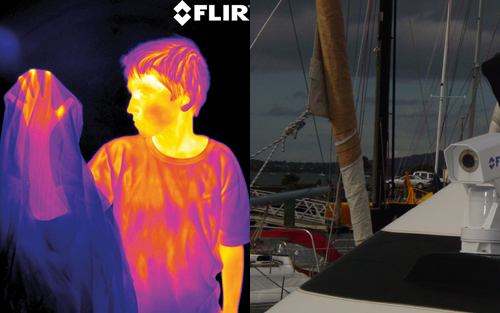
FLIR thermal imaging cameras began appearing on NZ boats around 2006 and since that time the technology has proven to be helpful in night time navigation. So what is FLIR and where did it come from? Well the name of the company “FLIR” was formed from the simple acronym of “Forward Looking Infra Red.” The company first began in 1978 and was built around the manufacture of aviation infrared systems. Since that time FLIR has become the world’s largest producer of thermal cameras and is listed on the NASDAQ exchange with a market capital of over 5 billion dollars.
The company went from strength to strength within it’s niche but a major milestone in FLIR’s history was in 1990 when it teamed up with the Hughes Aircraft Company, with Hughes taking part ownership of FLIR. Today most of FLIR’s revenue is still generated from air surveillance and specifically contracts for the military. FLIR’s commercial industrial divisions manufacture a wide range of visual thermal imagers for industry and non-military applications. These markets include scientific, security, marine and the auto industry. In fact you will find FLIR night time driving systems on many high end luxury cars. As you can expect, the application will dictate the quality and hence the price will vary accordingly. By example an entry level handheld device one may use for situation awareness sells for just over $1000 while a full gyro stabilised long range maritime surveillance system will set you back six figures.
How does Flir Work?
Although FLIR thermal imaging cameras look like a regular video camera they are far from it. They detect only infrared energy, and as a result the lens of a FLIR unit cannot be made of glass as glass is in fact a barrier to infrared. So you cannot use a FLIR unit within a cockpit of an aircraft or boat and expect to see anything through a windscreen (unless Perspex). Instead the lens utilises an expensive rare metal called germanium, due to its ability to conduct infrared.
At the core of each camera is a device called a microbolometer. This device detects infrared radiation with wavelengths between 7.5-14 μm. The microbolometer is a solid state device that changes in resistance depending on the energy focused on it. The microbolometer used in a FLIR camera consists of an array of pixels that can be measured and processed in order to create an image.
The FLIR core cannot see visible light whatsoever; it can only see light within the infrared spectrum. A lot of folk are sceptical on this point and when we first began distributing FLIR in 2006, no one had any idea about this technology. They simply would not believe that the camera could see without any light. We would demonstrate handhelds along the Auckland waterfront and customers were convinc-
-ed that the low light and moon over the harbour was providing sufficient light, it was only when they locked themselves in a cupboard did they actually believe.
Infra-red energy
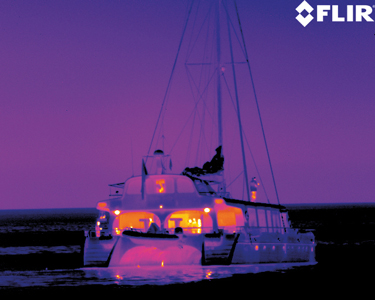
Every object emits infra-red light regardless of what temperature it is. Objects at well below freezing are still visible due to their infrared foot print, so even ice is easy to see. The difference between infra-red light and visible light is the wave length. Infra-red light has a much longer wave length. It happens however, that there is a correlation between the amount of infrared light given off and the actual temperature of the object. For this reason the technology has been used for many decades for non-contact temperature measurement. This can be helpful when trying to measure the temperature of very hot products such as molten glass and steel.
What and how far can you see?
This is the million dollar question we get asked most often, and the answer is “well it all
depends.” Firstly customers are amazed at the quality and clarity of the image. For the
most part the image from a FLIR marine camera is going to look the same as you would
expect from a black and white video camera. The image clarity and detail surprises
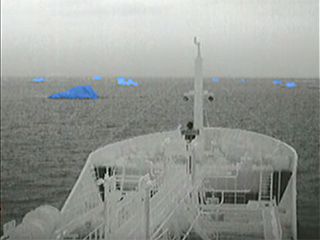
people as it is so clear that even debris like pieces of timber can be seen in the water.
This clarity of the real world makes life easy for the skipper as there is no requirement to
interpret data or patterns. What you see is what you get. Every skipper knows the feeling
of uncertainty when being forced to move to a quieter anchorage at night due to a
wind change, especially after having been awoken and trying to ascertain your surroundings.
FLIR really becomes useful when trying to navigate into a bay with other moored craft.
As for range, FLIR splits this specification into two specific definitions. Detection is the first point at when you clearly see an object appear on your screen whereas identification is when you clearly identify the target. By example, the image of a 50 ft launch will be identified much farther away than the distance one can identify a small runabout or kayak. FLIR publishes a conservative specification table for all their models, so you can decide which model will best suit your needs. The majority of sales we see are of the 320×240 microbolometer and they can detect a 4 metre vessel around 1.9km (1nm) which is adequate for collision avoidance even at speed.
Like all technologies there are limitations and environmental factors that come in to play and will affect range. The height of the imager relative to the sea is without question an important consideration, and the higher it is placed the better image quality and range.
The ambient air temperature too has an impact as the greater the differential between the surroundings and any warm object will translate to sensitivity. In general cooler dry nights have the best result.
Why dual payload models
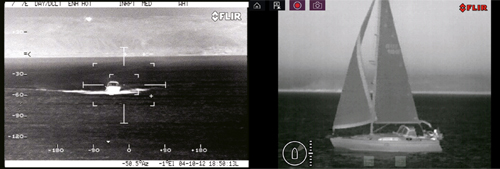
Harbours and rivers that surround cities can be affected due to the vast amount of heat that is created from cars, asphalt and buildings. An issue may arise within the period directly after dusk as all this heat translates to infrared energy. High levels can swamp the imager and greatly reduce the sensitivity and severely reduce the cameras functionality. Plus large cities provide large amounts of light and a quality low light colour camera can work equally well. For this reason FLIR introduced their dual payload cameras which is a smart term describing a system with both a FLIR and low light camera. By combining the two technologies the skipper can get the best of both worlds. Perhaps not a significant issue in New Zealand waters, however the Sydney commuter ferries found the dual payload low light camera the perfect tool for their busy harbour.
What is the difference between 9 Hz vs 30 Hz?
The 9- 30 Hertz models refer to the update speed at which the screen gets information from the camera. 9 Hz is nine times per second vs 30 times per second. The US government restricts what models can be sold and have limitations as to what models can be exported outside of the USA due to their security regulations. All FLIR sold within the USA are built at 30 Hz and cannot be exported. In practical terms the refresh rate has almost no discernible significance to a maritime user. The only way you can detect the difference between the models is if you were to focus in on a fast moving object that was travelling across the field of view. By example, if a bird was to fly across the screen at close range you may be able to detect a slight resolution or jerkiness in the motion. Given that the FLIR unit is by in large pointing directly ahead looking at objects far away in the distance the refresh rate has no relevance. However we have had customers wanting to order the higher resolution models and Absolute Marine has imported several of these units into the country. Absolute marine is authorised for 30Hz however delivery can be a little longer due to a fair bit of paper work.
A brief history of FLIR Maritime
In 2006 FLIR released the Mariner, their first product designed specifically for maritime night time navigation. They wanted a camera which could pan/tilt and was sufficiently ruggedized to handle the harsh marine environment. At that time FLIR did not have a suitable pan/tilt watertight housing, so they fitted their FLIR core inside a Jabsco remote controlled search light.
In the early days we had difficulty getting folk to even consider the FLIR technology and most did not take it seriously as a tool that could be used for navigation. However as word spread at just how good FLIR was for seeing small craft in the dark, especially where choppy seas limited radar images, the sales began to follow.
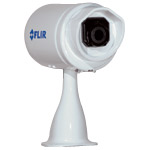
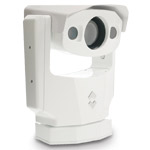
Commercial vessels, search and rescue were by far the biggest adopters of the new technology. Kiwis are renowned for their acceptance and uptake of new technology. The The first sales outside of the USA of the FLIR long range Voyager were in fact made to New Zealand boat owners.
FLIR soon learned that the Mariner wasn’t quite right for the market. For one it’s field of view was extremely wide which was great for looking around you, but skippers primarily use is to avoid hitting hazards while underway at speed. Plus the pan/tilt of the search light was found to be a bit clumsy and there was no feedback on the screen as to where exactly the camera was pointing. So FLIR set out to develop their own proprietary marinised pan/tilt camera and came out with the Navigator. This model was designed from all the things the Mariner was not, it featured a good balance in regard to the focal length and field of view. Plus it had a number of useful features including image zoom, colour pattern views and gain control, which meant it was more adaptable to suit various environmental conditions.
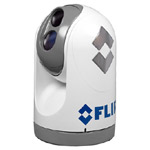
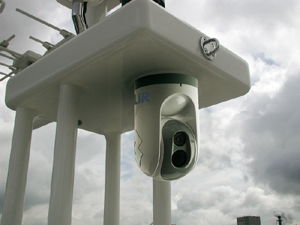
The next big step for FLIR maritime was in 2010 with the release of the award winning M series. This new range was superior in many ways. It had a great ergonomic look, robust housing and continuous 360° pan/tilt capabilities. Plus customers now had a choice of eight models including dual payload and long range at prices considerably less than their predecessors.
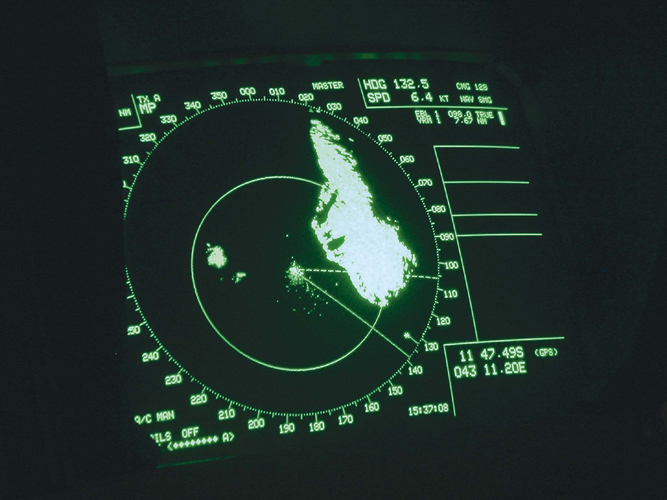
In 2012 the long range Voyager was retired and the capability of the Voyager was introduced into a much smaller lighter model housed within the M series dome. The M400 is the premium
camera within the M series range and offers two very significant benefits. One of the issues that FLIR wanted to improve upon with this new model is the rolling and pitching of the image that
is experienced in rough seas. The M400 electronically stabilises the image as if it was in a gyro. This stabilisation combined with the new communication interface made it very powerful
indeed, and meant that the M400 could now slew to cue and track from radar, AIS and chartplotter systems. The optional XR model has the added ability to lock on to any video selected target
on the screen as set by the user and fully track.
What next for FLIR
We have just taken delivery of the latest M100 and M200 low cost cameras from FLIR. In essence these cameras offer similar features to their predecessors, however they are Ethernet based and rely on a computer network in order to communicate and display the video image. This does reduce the purchase cost however, it is not possible to display FLIR on a conventional analogue multi-function chart plotter or analogue video display without the use of additional electronics.
It is exciting times for FLIR as these new lower cost units make it more affordable for a new generation of boaties to have FLIR as standard equipment and make boating safer even at night.
Steve Kershaw
Absolute Marine