

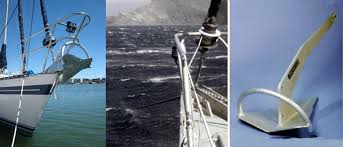
Below is a collection of various pieces of feedback on the Rocna. It covers a wide variety of locations worldwide and exploits a huge collective body of experience.
General
| “ |
…Anchoring was a problem last year. Our aging plow had seen better days and was starting to rust, a bit unsightly but not damaging. The fact that we dragged three times last year could however have been. We were just lucky. Now dragging your anchor doesn't just have a physical effect, it also has a psychological one. Every time you put it down you are thinking is it going to hold and every time the wind gets up in the middle of the night any chance of a good nights sleep goes out the window. We had talked to a number of cruisers last year about different anchors but we kept coming back to one in particular. Our friends aboard Spontaneous never dragged, even in the same areas we were anchoring in, they had a Rocna. We went and saw Rocna when we got back last year and it turns out the chap that designed it was a kiwi and a cruiser. The drag and set data they showed us was good and with the positive experience we already had we decided to buy one. Best anchoring decision, ever… our choice was a Rocna 33. This year we have anchored in mud, soft sand, hard packed sand, coral, shingle, and rock. We have been anchored in some extreme weather conditions too. We never moved. The anchor, once properly set, held tight in all conditions. Diving on the anchor, which in most instances we did, the anchor had set in less than it's length. We even tried setting it intentionally to windward and letting the boat fall off to lie to the wind (emulating a 180 deg wind shift), even in 30 knots with the boat moving at an alarming pace the anchor simply turned in its set position and dug in deeper. Lyn said the wheel nearly spun out of her hands the set was so sharp. |
” |
|
— John & Lyn Martin, Island Cruising Association (New Zealand) |
||
Specific bottom types
Soft bottoms (mud)
Chesapeake, USA
| “ |
My wife and I recently gave our new Rocna 30 its first test and I have to admit it passed admirably. It was the latter part of June and my wife and I had just slipped into a familiar anchorage on the East River of Mobjack Bay. The weather was hot and balmy and the water was glass like in appearance with a slight easterly breeze coming in off the bay. We had slipped past a couple of small thunderstorms earlier in the afternoon and we were looking forward to a quiet evening and another beautiful sunset. However, the gentle conditions did not last throughout the evening. Within an hour or so of dropping our new Rocna anchor for the first time, the rumble of distant thunder began to emanate from somewhere over the western shore. It wasn’t long after that, that thunderheads appeared in the sky to the west of our position. Within a couple of hours we found ourselves being bore down on by a severe Chesapeake Bay thunderstorm. As the approaching storm was bearing down on us, conditions went from calm and peaceful to a full fledged gale within ten to fifteen minutes. The winds changed direction abruptly as the wall cloud raced over our position and things really got wild. As the winds began to race through the rigging at 35 to 40 knots, our vessel immediately swung to port, healed over about 15 degrees and began to rapidly swing from port to starboard. The winds continued to build and to blow at what I estimated to be 45 to 50 knots and our 46 foot vessel was swinging like a kite on the end of a chain. At the end of each swing our vessel would shutter against the wind, heal over in the opposite direction and rapidly swing away downwind again. The rain was pouring by horizontally so hard we couldn't see anything out of the cockpit. The storm raged on for about an hour and all we could do was hang on, monitor our position on the hand-held GPS and hope for the best. It was, without a doubt, the worst storm we had ever been through on the bay. The Rocna, however, worked great throughout the storm and it never budged from its original set position. Later on the VHF we heard that the winds were measured at 60 knots at a nearby marina during the storm. In a couple of days when we pulled anchor, there was two to three inches of mud and a handfull of oysters on top of the roll-bar. Evidently the anchor had performed true to its billing at the website. It had completely buried itself in the soft bottom mud and hung there tightly throughout the storm. Thanks again for your advice and support. |
” |
|
— Dan & Debbie Skidmore, SV "About Time" (USA) |
||
Nanaimo Harbor, Vancouver Island, Canada
| “ |
This gave us a better understanding of the holding power of the Rocna. We had previously used our anchor half a dozen times and found it set quickly and seemed to hold fine. We had previously anchored in the mud bottom of Montague Harbor in about 35 knots of wind, and found it took a bit of effort to get the anchor back. Later we happened to be anchored in the rather open roadstead of Nanaimo Harbor during a SE blow. The anchorage S of Newcastle Island was rather crowded, so I pushed to S boundary where a cable marks the S edge of the regulated anchorage to leave room for the float planes to operate. That night I napped in the watch berth and saw 55 knots on the Airmar coming from the SE with about 3 miles of fetch. We had numerous boats anchored astern and I was concerned about dragging. Due to the lack of room, I only had about 200 feet of scope out in 45 feet of water at low tide. The swells built to 3 or 4 feet and lots of trees and lumber were coming down on us from the flats at the south end of the bay. Several times I started the engine and motored to the side while anchored to avoid an oncoming tree! We noticed that several boats had blown up on the beach during the night. Later the next morning the wind had died down some and we decided to move into the marina. I motored up into the wind and retrieved rode while Dona directed me from the bow. With the still gusty conditions, I could get all but 70 ft back, so I tied the rode off to the Samson post and powered ahead to unset the anchor. After many unsuccessful tries, I decided I must have hooked the cable to Protection Island. By this time the wind had backed to the West and was increasing again, so I kept the rode short in hopes that the new wind direction with gusts to 40 knots would free my anchor. No such luck. I located a diver who lived aboard in the anchorage and he arrived as soon as the wind died down a bit. He suited up and went down the rode leaving us with instructions to keep letting out scope after 30 seconds to give him slack to unhook the anchor from the cable. After a while he resurfaced and asked what the heck kind of an anchor that was. All he could see was part of the shank, but he dug down in the mud to the fluke without finding the cable. He then walked around the bottom to see if he could find the cable. It was about 5 feet South of my anchor. He told me to just keep pulling harder. With knowledge that we wouldn’t damage the cable and a lot of powering over the top of the anchor, we were able to unset it. Since I set the anchor to the south and backed down on it to the north, and since the greater part of the storm was from the South, this tells me that the Rocna dug in and stayed put… even with short scope and swells. |
” |
|
— Rob Bonner, MV "Maritime" (Canada) |
||
Pacific Islands
| “ |
I bought mine especially because of Fiji. I could not get my Deltas to hook up in the mud you are going to find there. Dragged twice and almost lost the boat, both times in Fiji. Before I went back last year I decided to get a real anchor. Here's the deal on the Rocna… It hooks up every time, resets quickly, and makes me sleep soundly at night. I experimented in setting the anchor all of last year. I'd dump all the chain over it, run forward and drop the hook, even run sideways… it hooked every time and I did no have a single occurrence where I had to reset and drop it again. This is in mud, sand, gravel and the icky stuff in Sola Vanuatu where everybody dragged except me. Really amazing stuff. Still have one Delta but I doubt I'll ever drop it again. |
” |
|
— Robert Jackson, SV "Holokai" (USA) |
||
Moderate bottoms (sand / firm mud)
| “ |
…The forecast is not good: force 6-7 for the next two days at least. We head back, just in time to see the wind go from southerly force 1 to northwesterly force 6 within two minutes… As the gusts increase we decide to put out our kedge at 45 degrees to the bower to make life more comfortable. By 1800 gusts are to more than 40 knots, several boats have dragged but we feel quite secure. We spend the time comparing the motions of a long-keeled Dutch boat, perhaps sheering 45 degrees, with a Bavaria 42 that must be making 180 degrees. He has dragged several times… With our two anchors (chain plus snubber to the Rocna and Anchorplait to the Fortress) we are doing about the same as the long-keeler, as is another British boat also on two anchors… The Rocna is a revelation. It has been buried throughout the three days but now the floating line and buoy attached to its head only protrude about 8 inches from the bottom. The line is 3 feet long! By 1700 it is again gusting to 40 knots and a French boat astern has dragged four times since 1200, first on a Claw and then on a Brittany… |
” |
|
— Vyv Cox, TheMainSail.com |
||
West Marine Cruising Associate Marc LeBlanc (US East Coast and Bahamas)
| “ |
My name is Marc LeBlanc and I am a West Marine associate in Annapolis, MD. …I had just purchased a Rocna and would be happy to provide feedback on its performance during my annual cruise, down the US east coast, to the Bahamas. We anchor nearly every night during the winter in a variety of bottom types and conditions. From the soupy mud of the ICW creeks, to the hard coral sand of the Bahamas. My wife, Alison, and I could not have been happier with our choice of the Rocna. I have cruised for many years and have used most of the popular anchor types and none perform as well or as consistently as the Rocna. Alison actually requested the anchor as an anniversary gift this past fall, and has been bragging about it all winter! It was a windy winter in the Bahamas this year and we held firm wherever we put the anchor down. It always set quickly and never pulled out during the wind shifts that accompanied the numerous cold fronts. As a marine products retailer, I have seen lots of new products come and go, and I am not easily impressed with many of them. I will have no trouble selling your anchor, as it is a product I have faith in and can enthusiastically endorse. The Rocna is, quite simply, the best anchor I have ever used. Congratulations on a superior product. |
” |
|
— Marc LeBlanc, SV "Angel" (USA) |
||
Hard bottoms (packed sand / clay)
Hobart Australia
| “ |
The performance of the Rocna has been faultless and I am glad to pass on my experiences when asked… We have just completed our sail to Hobart as a participant in the inaugural CYCA Cruise and I am writing to tell you how happy I am with the performance of my new Rocna 15. First time wet was in the hard sand of East Boyd Bay. We had 30+ knots for a couple of hours and the anchor held firm while CQRs on a couple of neighbouring boats were giving all sorts of problems. Again in a bay on the west side of Maria Is we had well over 30 knots, this time with a steep chop and the anchor did fine. In addition to performance, the Rocna is so much easier to move around the boat than my old CQR, it is a joy. |
” |
|
— David Champtaloup, CYCA Cruising Division Commodore |
||
Grass, weed, and kelp
Grass in the Bahamas
| “ |
When we were in the Bahamas, I took a number of pictures of the anchor set… It didn't matter if it was grass, partial grass, or just sand. It always set. On top of that, you better not be going back too quickly when you are setting the anchor in reverse or you will get whiplash. It sets great and then you can run the reverse up to whatever you want, slowly, to finish the set. We typically go up to 2,000 rpm and then have our anchor wine. We watch people drag all the time right past our position and have to say, the Rocna decision was wonderful. |
” |
|
— Jim Faughn, SV "Freedom" (USA) |
||
Thick grass
| “ |
My new Rocna has been a flawless performer so far… My CQR could never penetrate eel grass and this thing just burrows into it like a hot knife through butter… Heck I even tested my Rocna on my very thick, dense, and healthy lawn with my car… It set and buried in 3.5 feet. |
” |
|
— Rodd Collins, Maine USA |
||
Western Mediterranean weed/grass
| “ |
We have had for a long time a 65 lb CQR and a 45 lb CQR on the bow, and a large Fortress on the stern. For five years in the UK, Atlantic Spain, Portugal, and Morocco this was great… Once we got to the weed and grass of southern France things looked very different. The CQR really struggled to bite in that grass and we were hoiking up lots of it in repetitive attempts to anchor. (Yes, we back down, yes we dive, and if we aren't comfortable, we pull it up and start again.) We tried with the 45 lb and the Fortress and neither of them were good either. So we took a deep breath and bought the 55 lb Rocna [25], which we've only used for about a month and so far strongest winds are 35 knots. However, we've been very pleased with it as it sets really well, including in thick weed, and stays there. |
” |
|
— Sarah & Pip, SV "Roaring Girl" |
||
Heavy kelp and weed
| “ |
The Rocna has worked well for us in thin sand over coral in the S Pacific, heavy weed in the Bahamas, alluvial rock fans in Alaska and Greenland, and heavy kelp in Greenland and Labrador. No weaknesses that we have seen… We were initially concerned with the roll bar possibly being prone to fouling, but this has not been a problem. The one feature we prefer on the Rocna to the other similar hooks is the very pointy end. This looks good for rock and getting through weed. We often anchor on 2-1 scope in tight locations with good results – but then we have a big (in scale) anchor. |
” |
|
— Steve Dashew, MV "Wind Horse" (USA) |
||
Kelp in Chilean Patagonia
| “ |
I am a retired Australian ship's master and have been sailing Westerly Serenade in southern Chile since February 2004. I have now logged in excess of 11,000 miles in these waters and have anchored in some 150 different Chilean anchorages. …I had been experiencing difficulty with my old CQR in the anchorages in the Canales del Sur de Patagonia, spending some time and effort at the end of each day trying to get it to set in many of the anchorages which have varying bottoms but often involve a lot of kelp. Since fitting the Rocna on my 39 foot Westerly Sealord I have used it in over sixty anchorages between Puerto Montt and Puerto Williams/ Punta Arenas [Chile] and it has set hard first time on every occasion. |
” |
|
— Frank Holden, SV "Westerly Serenade" |
||
Rock and coral
Rocky & mixed bottoms, Britain
| “ |
I have also used a Rocna anchor throughout this year. At the end of last season I replaced the old 35 lb CQR anchor on my Seahawk with a 15 kg Rocna… I made the change as I was sick and tired of re-laying the old CQR which never wanted to attach itself to any type of seabed! The decision was accelerated following one particular incident whereby we were anchoring in a sandy bay off Anglesey, North Wales in an offshore breeze (F3) in good weather. It took 6 attempts to lay the CQR as it just would not dig in, and we slowly slid backwards out of the bay 5 times! During the 5th attempt, I somehow managed to badly twist my ankle going forward but still managed to get the anchor over the side, only to see the boat sliding backwards again! The sixth attempt was semi-successful but only because the wind died to nothing, and I let out loads of chain which probably held the boat rather than the anchor digging in! The difference this year has been quite amazing. I have set the Rocna in sand, mud, weedy bottoms, and rocky bottoms and have never had to re-lay the anchor as it has set first time, every time, all year. Its first test was a little nail-biting though, following a passage from Holyhead to Port Dinllaen (about 25 miles) in a F4/5 'thrash to windward' in a lumpy sea. Upon arrival, the engine failed to start due to an air bubble which had found its way into the fuel line, so after a quick dash for the spanners and bleed-through of the fuel system which failed to remove the air, we decided to anchor under sail. We tacked our way into the bay, rolled away the genoa and continued with full main in the now dying breeze as we moved closer to the shore. We dropped the Rocna in 4 meters and let the wind slowly |